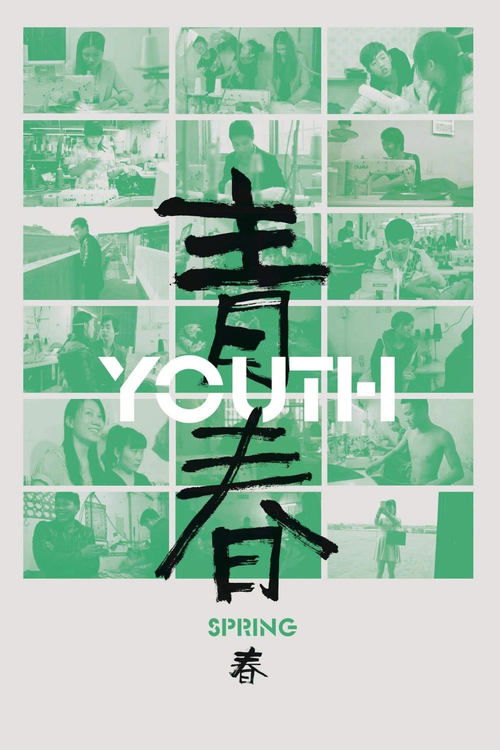
Youth (Spring)
Nov 10, 2023 | IMDB 6.7
212 min Watch NowDocumentary
This film was shot between 2014 and 2019 in the town of Zhili, a district of Huzhou City in Zhejiang province, China. Zhili is home to over 18,000 privately-run workshops producing children's clothes, mostly for the domestic market, but some also for export. The workshops employ around 300,000 migrant workers, chiefly from the rural provinces of Yunnan, Guizhou, Anhui, Jiangxi, Henan and Jiangsu.
MOVIE COMMENTS
SIMILAR MOVIES
After Breaking the Silence
Plastic China
In the Same Breath
Le réveil des ombres
10 Questions for the Dalai Lama
Into the Island
Crude Oil
24 City
Pathway
A Hakka Song
Railroad of Hope
Inside Red China
Little Sahara
Group of dancers
I Am Big Bird: The Caroll Spinney Story
Crocodile in the Yangtze
Man Versus Man
Tailor Made: The Story of Rochester's Garment Industry
Maineland
Manufactured Landscapes
SIMILAR MOVIES
After Breaking the Silence
IMDB 0 | May , 2016
4, April, 2014. Worker's who worked in "SaengTak" are get to the struggle to require adjust of working environment for safely food, and guarantied a Three Right of labors. Then. Worker's tried to record there's own struggle and launch forth to street, However, Law, Capital, unconcern of crowd and avoid of famille are swallow up them.Plastic China
IMDB 7 | Jan , 2017
This film tells a story about an unschooled 11-year-old girl Yi-Jie, she's a truly global child who learns the world through the United Nations of Wastes while working with her YI minority parents in this recycle workshop thousand miles away from their mountain village home townIn the Same Breath
IMDB 7.1 | Jan , 2021
This documentary recounts the experiences of people on the ground in the earliest days of the novel coronavirus and the way two countries dealt with its initial spread, from the first days of the outbreak in Wuhan to its rampage across the United States.Le réveil des ombres
IMDB 0 | Nov , 2016
Documentary about new chinese cinema.10 Questions for the Dalai Lama
IMDB 7.1 | May , 2006
How do you reconcile a commitment to non-violence when faced with violence? Why do the poor often seem happier than the rich? Must a society lose its traditions in order to move into the future? These are some of the questions posed to His Holiness the Dalai Lama by filmmaker and explorer Rick Ray. Ray examines some of the fundamental questions of our time by weaving together observations from his own journeys throughout India and the Middle East, and the wisdom of an extraordinary spiritual leader. This is his story, as told and filmed by Rick Ray during a private visit to his monastery in Dharamsala, India over the course of several months. Also included is rare historical footage as well as footage supplied by individuals who at great personal risk, filmed with hidden cameras within Tibet.Into the Island
IMDB 0 | Jan , 2023
Into the Island is the first chapter of Groundwork, a three-part film and exhibition series exploring the conceptual development and field research of contemporary architects cultivating alternative modes of engagement with new project sites.Crude Oil
IMDB 7.2 | Jan , 2008
Filmed in the Inner Mongolian portion of the Gobi Desert, this film follows a group of oil field workers as they go about their daily routine.24 City
IMDB 7 | Sep , 2008
As a decades-old state-run aeronautics munitions factory in downtown Chengdu, China is being torn down for the construction of the titular luxury apartment complex, director Jia Zhangke interviews various people affiliated with it about their experiences.Pathway
IMDB 3 | Mar , 2012
Xu Xin’s film “Dao Lu” (China 2012) offers an exclusive “in camera” encounter with Zheng Yan, an 83 year-old veteran of the Chinese Red Army, who calmly relates how he has navigated his country’s turbulent history over three-quarters of a century.Born to a wealthy family in a foreign concession, Yan joined the Chinese Communist Party (CCP) in 1941 because he sincerely believed in the socialist project, and in its immediate capacity to free China from the Japanese yoke and eradicate deep-rooted corruption.A Hakka Song
IMDB 0 | Apr , 2024
A song is heard in the distance. It comes from the Hekeng village, famous for its ancient earthen buildings, also called tulou. It is where the last original Hakka families live amidst the exodus of those looking for a more modern environment. Among them there is Zhang Zhouyin, an elderly man concerned about the state of the village's temple; or her daughter-in-law, Wei Yi, who spends her entire day guiding tourists through these awe-inspiring houses. And then there’s young Zhang Weibo, her son, who manages to find joy even in the simplest of things... Hekeng: a place frozen in time whose songs have endured for centuries.Railroad of Hope
IMDB 5 | Dec , 2002
Railroad of Hope consists of interviews and footage collected over three days by Ning Ying of migrant agricultural workers traveling from Sichuan in China's interior, to the Xinjiang Autonomous Region, China's northwest frontier.[1] Through informal interviews aboard the cramped rail cars, Ning Ying explores the hopes and dreams of the workers, many of whom have never left their homes before.Inside Red China
IMDB 8 | Aug , 1958
October 1st, 1957. Dusk descends on Tiananmen Square, Peking. Fireworks crackle light across the night sky, above a city alive with National Day festivities and celebrations. Two intrepid New Zealand film-makers - Rudall and Ramai Te Miha Hayward - are there, documenting the life and times of communist China. The distinction of being the first English speaking foreigners to film unfettered in communist China was significant. The invitation to visit China was facilitated through the New Zealand China Friendship Society. They filmed in Canton, Shanghai, Peking (Beijing) and Wuhan. It was a small window of opportunity for Westerners to gaze on a country that was largely a mystery to the outside world since 1949. The unfortunate irony was that two of the documentaries; “Wonders of China”, and “Inside Red China”, were considered to be communist propaganda, and were not distributed outside of New Zealand.Little Sahara
IMDB 0 | Jul , 2023
Those who do not know the Sahara think there is only sand in the desert. But in the desert there are children who play and draw and make movies, and who would like to not have to think about the war. In the desert there's a European colony, an occupied country called Western Sahara, where there are thousands of Sahrawi refugees living a hard life in exile. "Little Sahara" tells their story, the story of a supportive, resilient people who try to thrive and grow in the Hamada, where everything has a hard time growing.Group of dancers
IMDB 7 | Jan , 1905
Cultural documentary featuring a Chinese folk dance performance held in the courtyard of Auguste François's house in Yunnanfu, present-day Kunming, China. Four dancers interact in an artistic performance. Produced in 1901 by Societé L. Gaumont et Cie. and directed by French photographer and diplomat Auguste François. Working as a French diplomatic consul in China, Auguste François shot a large number of films, most of which are still preserved, showing aspects of Chinese society in the last years of the last Chinese monarchical dynasty, the Qing. This film was only released commercially in 1905 as part of the collection "Au Pays des Mandarins".I Am Big Bird: The Caroll Spinney Story
IMDB 7.4 | May , 2015
A documentary about Caroll Spinney who has been Sesame Street's Big Bird and Oscar the Grouch since 1969. At 78-years-old, he has no intention of stopping.Crocodile in the Yangtze
IMDB 10 | Apr , 2012
Crocodile in the Yangtze follows China's first Internet entrepreneur and former English teacher, Jack Ma, as he battles US giant eBay on the way to building China's first global Internet company, Alibaba Group. An independent memoir written, directed and produced by an American who worked in Ma's company for eight years, Crocodile in the Yangtze captures the emotional ups and downs of life in a Chinese Internet startup at a time when the Internet brought China face-to-face with the West. Crocodile in the Yangtze draws on 200 hours of archival footage filmed by over 35 sources between 1995 and 2009. The film presents a strikingly candid portrait of Ma and his company, told from the point of view of an “American fly on a Chinese wall” who witnessed the successes and the mistakes Alibaba encountered as it grew from a small apartment into a global company employing 16,000 staff.Man Versus Man
IMDB 0 | Jan , 1981
Man-pulled rickshaw, which have served Kolkata for over eight decades face virtual extinction as a result of legislation introduced by the State Government in 1981. This would rob over 100,000 people of a living. The film analyzes the critical situation, and on the basis of concrete facts and figures, questions whether such a step would be fruitful at all. The image of a man pulling a man is a depressing and a negative one - but not more negative than that of the image of a man going without food.Tailor Made: The Story of Rochester's Garment Industry
IMDB 0 | Feb , 2016
WXXI captures the story of Rochester’s garment industry and the people who contributed to it in this documentary that showcases the rich history of Rochester’s clothing industry. From Michaels-Stern & Co. to the Button Factory, to Hickey Freeman, it tells of the clothiers who revolutionized the garment business and the immigrant workers who made Rochester a key player in the industry.Maineland
IMDB 4.6 | Mar , 2017
Chinese teenagers from the wealthy elite, with big American dreams, settle into a boarding school in small-town Maine. As their fuzzy visions of the American dream slowly gain more clarity, their relationship to home takes on a poignant new aspect.Manufactured Landscapes
IMDB 7.2 | Sep , 2006
MANUFACTURED LANDSCAPES is the striking new documentary on the world and work of renowned artist Edward Burtynsky. Internationally acclaimed for his large-scale photographs of “manufactured landscapes”—quarries, recycling yards, factories, mines and dams—Burtynsky creates stunningly beautiful art from civilization’s materials and debris.